


It’s 2:00 PM on July 2, 1976, and Valley Forge State Park is filling up with covered wagons.
They’re coming from every direction. From the west on the Great Wagon Road. From the south through Virginia. From the north through New York. Conestoga wagons and Prairie Schooners, canvas tops bleached by a year of sun, wheels caked with mud from a dozen states. Riders on horseback flank them, hundreds deep. The sound is enormous — hooves, wheels, harness brass, people shouting. After 15 months, 17,000 miles, and 249 official encampments, the Bicentennial Wagon Train Pilgrimage has come home.
Before we go any further — if you’re enjoying these Sunday letters, so you never miss one. They’re free, and they land in your inbox through July.
More than 300 wagons converged on Valley Forge that afternoon. Nearly 5,000 people on horseback rode with them. They set up camp below the National Memorial Arch — the same field where Washington’s army had suffered through the winter of 1777-78. The wagons parked in rows. The horses were unhitched and watered. Campfires started. For one night, Valley Forge looked the way it might have looked 200 years earlier, except that the wagoneers had Winnebagos parked behind the tree line and a Penn State musical to perform after dinner.
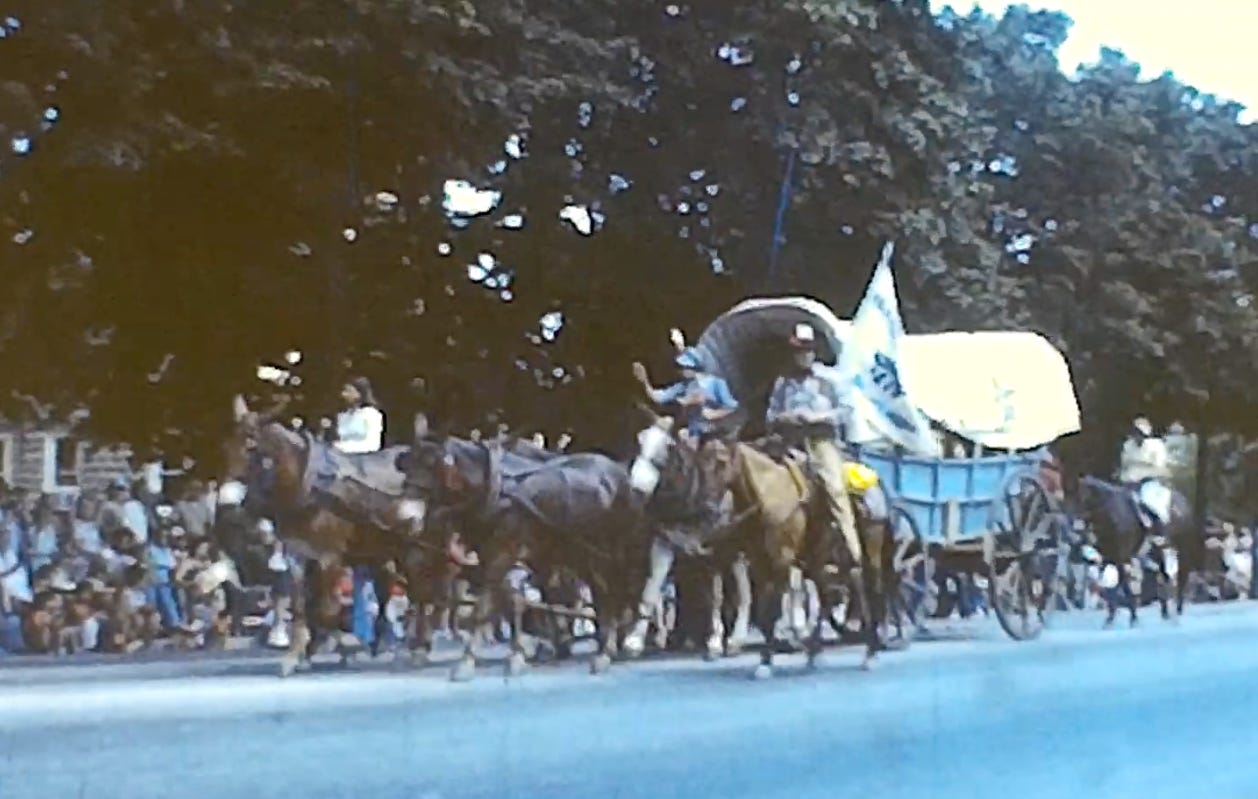
An estimated 850,000 people visited the encampment over July 3rd and 4th. On July 3rd alone, roughly 80,000 showed up.
Then came the morning.
July 4, 1976. The 200th birthday of the United States of America. It rained early. The crowd waited. And then, just after 8:45 AM, a helicopter appeared over the park.
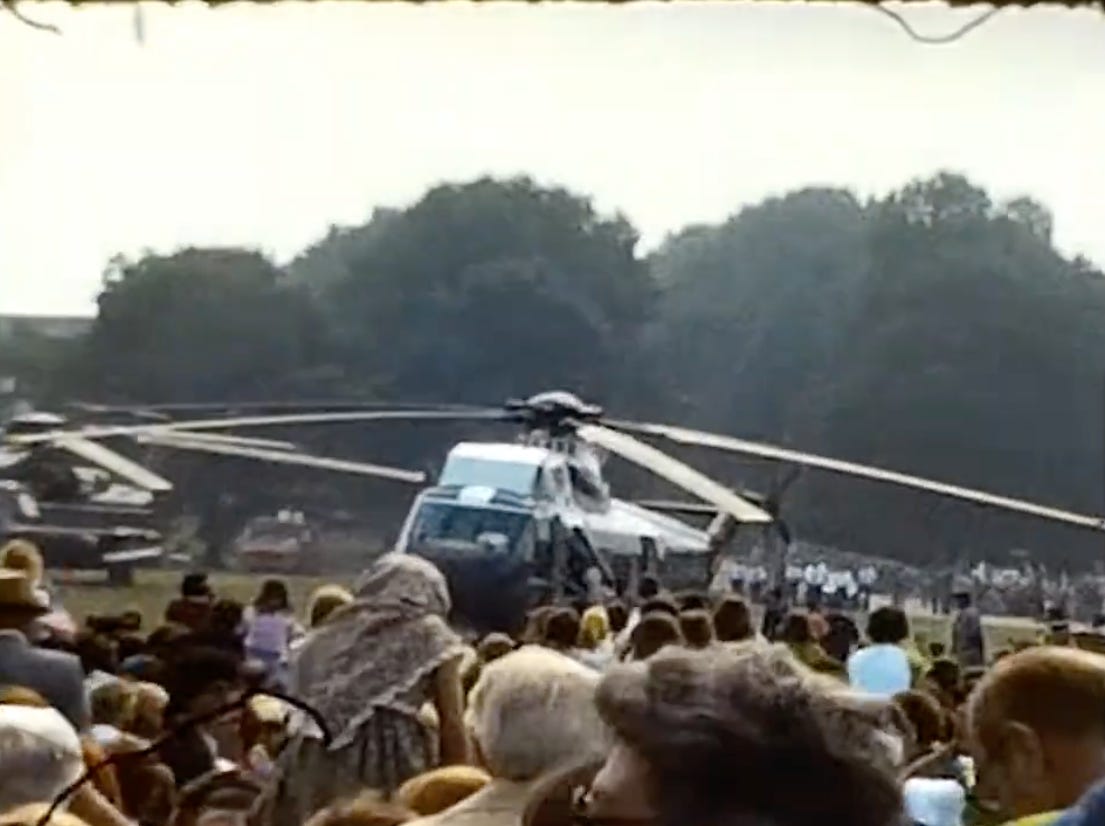
President Gerald Ford stepped out with his 18-year-old daughter Susan. Secretary of the Interior Thomas Kleppe and Representative Richard Schulze of Pennsylvania had flown with them. The crowd roared.
Ford walked to the wagon train encampment. He greeted the wagonmasters. He accepted the Rededication Scrolls, the signed pledges that 22 million Americans had put their names to in town squares and fairgrounds and school gymnasiums across the country. One in ten people in the nation had signed a scroll. One of the last people to add his name was Ford himself.
Then Ford did something that had nothing to do with wagons but had everything to do with the ground he was standing on. He signed the legislation making Valley Forge a National Historical Park. Pennsylvania was giving Valley Forge to the nation. The state park became a national park, right there, on that field, with the wagons behind him.
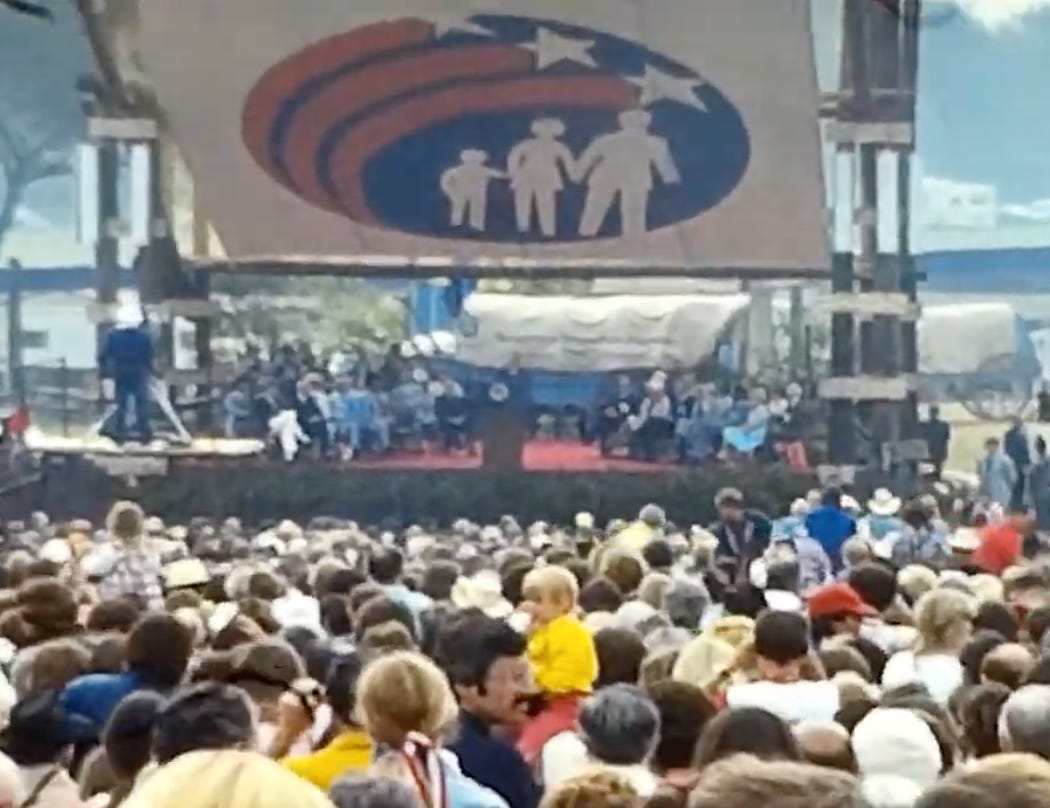
Ford’s speech began at 9:10 AM. It was broadcast on live nationwide television. He spoke for about 20 minutes. Then he was gone.
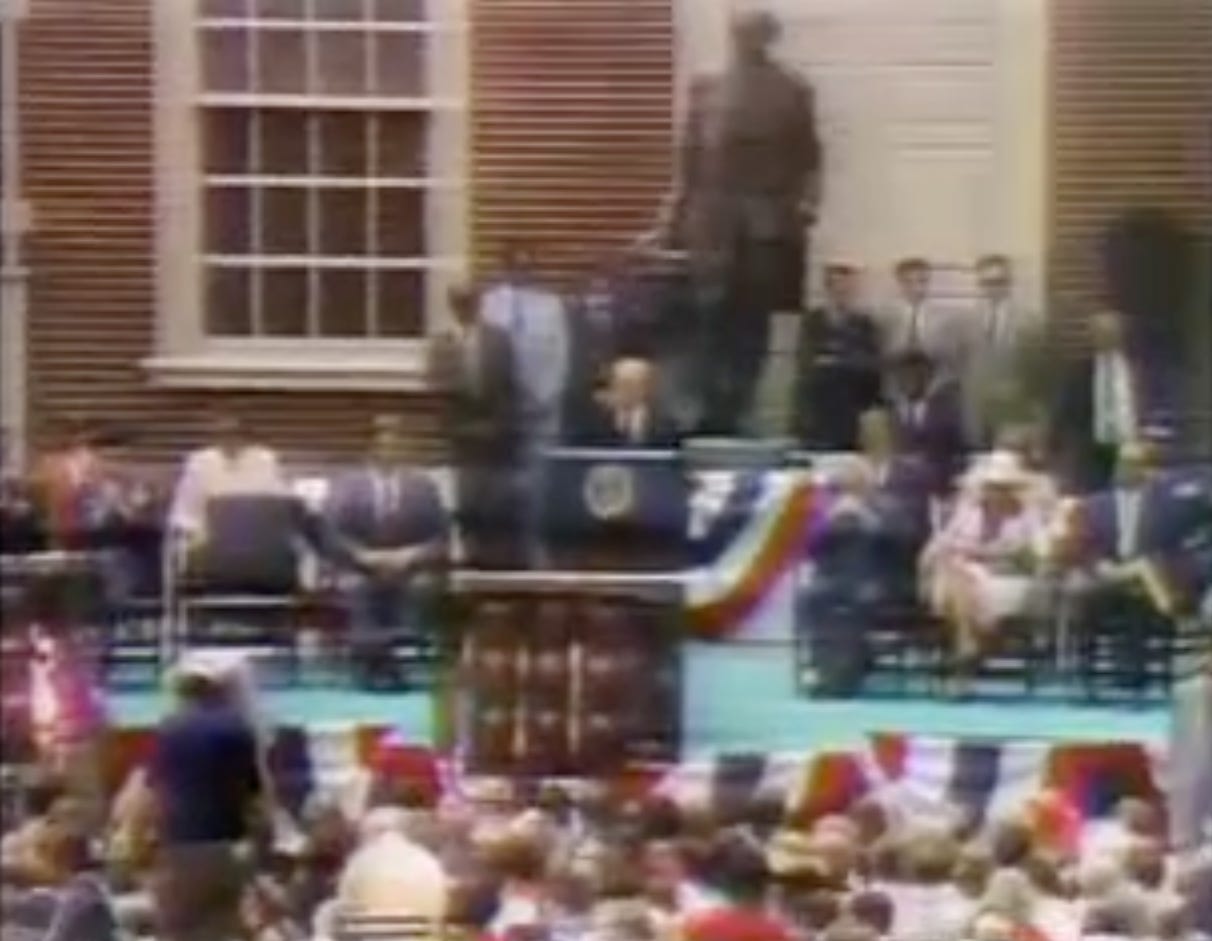
By 9:40 AM, Ford and Susan were back in the helicopter, lifting off for Philadelphia. They landed 20 minutes later. At Independence Hall, Ford signed the Bicentennial Day Declaration and gave another address. By 1:00 PM, they were airborne again — this time heading for New York Harbor, where Operation Sail was underway and 200 tall ships from 30 nations were filling the harbor.
Ford landed on the deck of the USS Forrestal. Betty Ford met them there — she had flown directly from Washington. At exactly 2:00 PM, Ford rang a ceremonial bell 13 times, one for each original colony. All across the country, other bells rang at the same moment. The Liberty Bell in Philadelphia was tapped. Church bells sounded in small towns. For two minutes, America rang.
By late afternoon, the Fords were back at the White House. That evening, they watched fireworks from the Truman Balcony — the display that an estimated 500,000 people saw from the Mall below.
The President of the United States had traveled over 500 miles by car, helicopter, and airplane in a single day. Valley Forge, Philadelphia, New York, Washington. Four cities. Four speeches. One bill signing. Thirteen bell rings. And he started the morning standing next to a covered wagon.
Back at Valley Forge, the wagoneers stayed.
The encampment continued through the entire summer, all the way to September 30. The Penn State shows kept performing. Visitors kept coming. But the core group — the people who had ridden for months, who had quit jobs and pulled kids from school knew the big moment had passed. Holly Gruver Franciamone, whose father had coordinated the entire pilgrimage, remembered the end of July 4th as bittersweet. The people she’d spent months with on the road were going home. It was over.
And the scrolls?
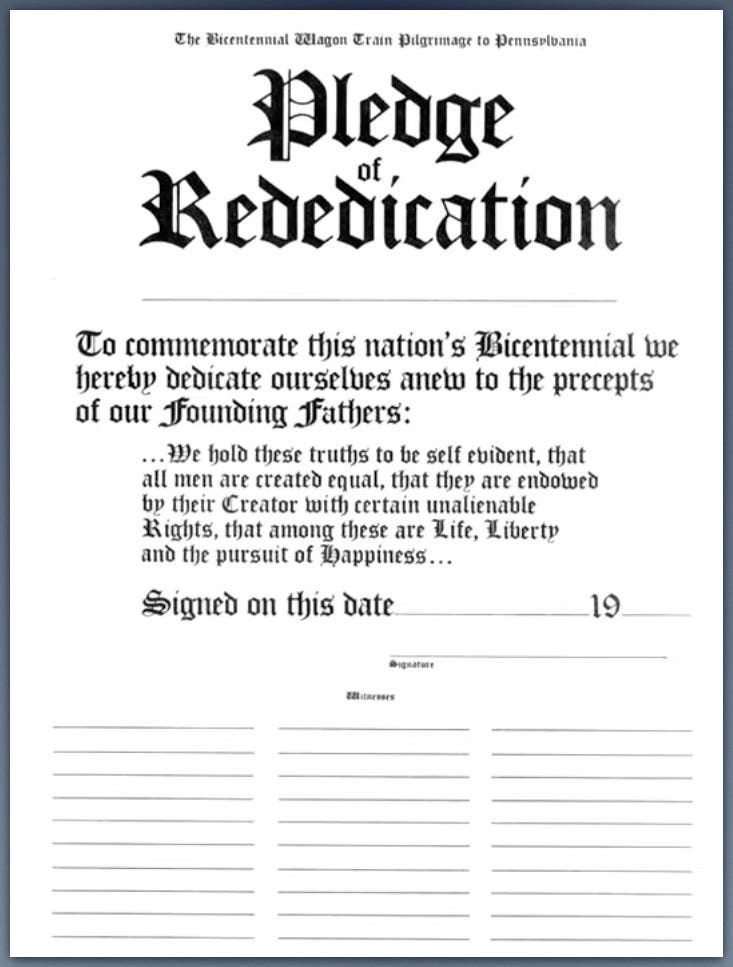
Twenty-two million signatures on paper. Each scroll had spaces for 24 names. That’s roughly 917,000 sheets of paper. Stacked, they’d stand as tall as a 20-story building. They were supposed to be enshrined at Valley Forge. Some were reportedly microfilmed. But over the decades, the physical scrolls seem to have disappeared. The last superintendent of Valley Forge as a state institution is gone. The woman who oversaw PR for the wagon train is gone. The park’s chief advocate and preservationist is gone. Almost everyone who could say where those scrolls went has died.
Somewhere — in a basement, a storage unit, a government warehouse — there may be a stack of paper 214 feet tall with the signatures of 22 million Americans who, in the spring and summer of 1976, sat down at a table draped in stars and stripes and signed their name next to a pledge about freedom. A boy in Wisconsin used a fountain pen and India ink because his mother said it would be more authentic.
Nobody has found them yet.
This wraps up the three-part Bicentennial Wagon Train series. Part 1 covered how the pilgrimage got approved. Part 2 covered life on the road. If you missed them, they’re in the archive.
The Bicentennial Wagon Train Pilgrimage to Pennsylvania 1976 Facebook group has been collecting memories from participants for years — photos, journals, audio cassette recordings. If you were there, or if someone you love was there, go find them. A fantastic resource.
Did You Know?
Ford’s July 4th schedule was planned minute by minute. White House memos from the Gerald R. Ford Presidential Library show the day timed down to five-minute increments — including a 35-minute block marked simply “PERSONAL” at a Philadelphia hotel suite between events.
The White House debated 53 separate planning questions for the July 4th weekend. Should the President plant a tree? Should he issue a proclamation to Americans overseas? What did Grant do at the Centennial? Should Cabinet members have assigned Bicentennial duties? The memo reads like a final exam.
Seven different speech outlines were drafted for Ford’s July 4th addresses. The White House consulted Dr. Daniel Boorstin (Librarian of Congress) and Dr. Irving Kristol to develop themes. Ford met with advisors the morning of June 15 to choose his direction. The deadline for first drafts was one week later.
The wagons stayed at Valley Forge through September 30, 1976 — nearly three months after the July 4th celebration. The state wagons remained on display for visitors all summer long.
Your Turn
Were you at Valley Forge on July 3rd or 4th, 1976? Did you see the helicopter? Did you watch it on TV? Were you somewhere else that day — at a parade, a cookout, a fireworks show — while Valley Forge was happening? What do you remember about the Fourth of July, 1976?
Email your memory to bicentennialmemoryproject@gmail.com or drop it in the comments.
Six days!! In six days, America turns 250. Fifty years ago this week, a president stepped out of a helicopter at Valley Forge and signed a piece of paper next to a covered wagon. What will you do to remember about this week?
—Denyse
Bicentennial Memory Project