


It’s a Tuesday morning in April 1976, somewhere on a two-lane highway in eastern Kansas, and you can hear the wagon train before you can see it.
The clip-clop of heavy draft horses on asphalt. The creak of wooden wheels with hidden roller bearings. The jingle of harness brass. Then the first Conestoga comes around the bend, canvas top swaying, and behind it another, and another — 40 wagons long, with riders on horseback flanking both sides. They’re doing about four miles an hour. They have been doing four miles an hour since last June.
Before we go any further, if you’re enjoying these Sunday letters, subscribe so you never miss one. They’re free, and they land in your inbox every week through July 2026.
This is what the Bicentennial Wagon Train Pilgrimage looked like from the road.
In Part 1, we covered the memos — how a Philadelphia ad agency and the Pennsylvania Bicentennial Commission convinced the federal government to send covered wagons across America. Today we’re on the trail. What did it actually feel like to ride in one of these things? What happened when the wagons pulled into your town?
The daily rhythm was simple and relentless. Wake up. Hitch the horses. Roll 20 miles. Make camp. Put on a show. Do it again tomorrow. The draft horses pulled three days and rested every fourth day, rotated with fresh hitches so no team was overworked. The saddle horses — ridden by outriders, local volunteers, and anyone who showed up with a mount — had it harder. They carried weight. But most only rode part of the route, peeling off after a day or two while the core crew kept moving east.
The core crew was young. Five separate companies of Penn State University students — actors, singers, musicians — traveled with the five wagon train segments for the entire journey. They lived together in pairs of Winnebagos, one for the men, one for the women. They performed a patriotic musical written specifically for the pilgrimage every single night at every single stop. Over 2,000 performances in 15 months.
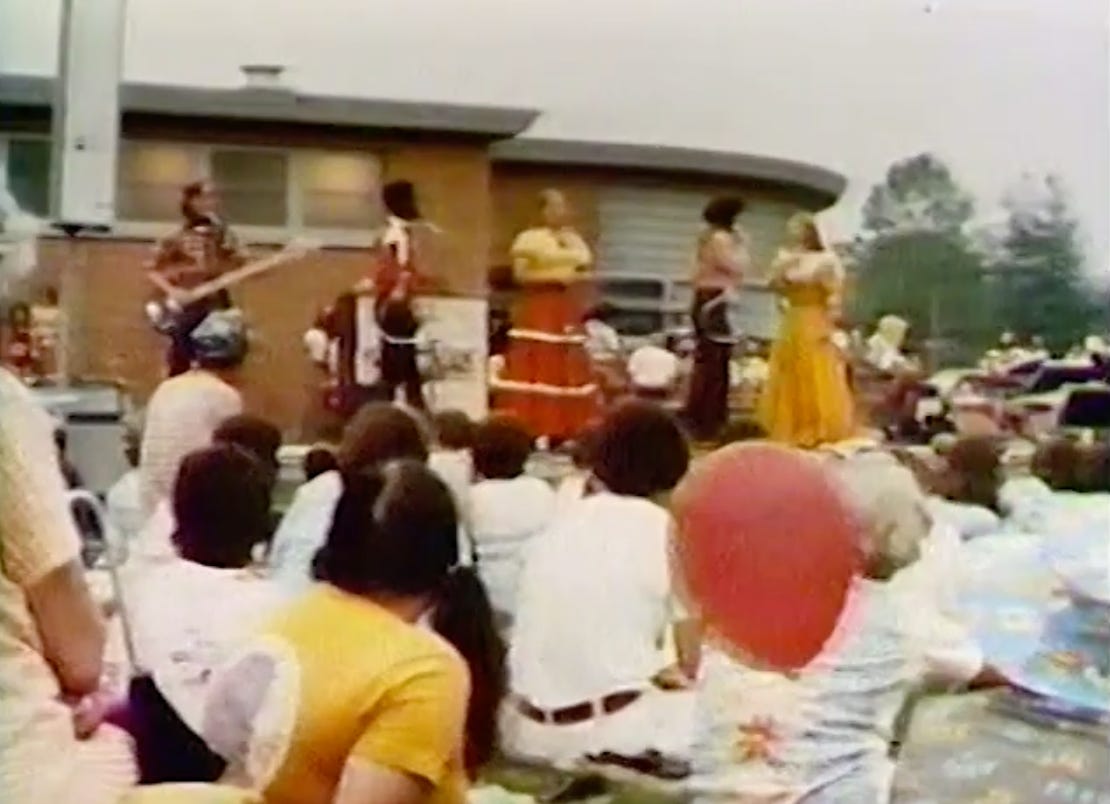
Think about that. These were college kids in their early twenties, sleeping in Winnebagos, performing the same 45-minute show in a different small town every night for a year. They did it in rain. They did it in South Carolina heat and Wyoming cold. The wagons were designed to fold open into portable stages, and the performers climbed up and performed in period costumes — buckskins and calico — under whatever sky showed up that evening.
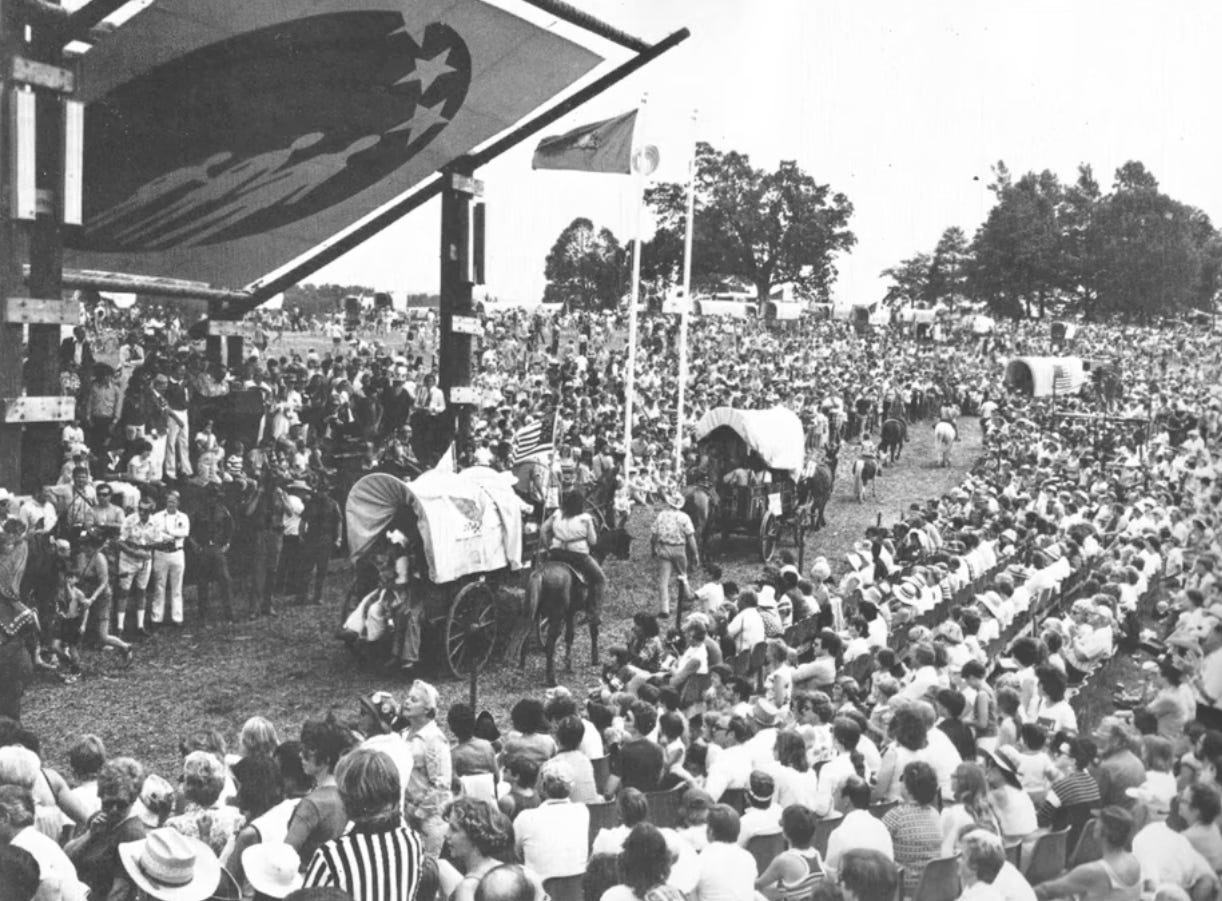
The audiences loved it. Towns didn’t just watch the wagon train pass through. They came out and met it. Local saddle clubs rode alongside in period costumes. Women held quilting bees. Somebody always made soup in an iron pot. School bands played. 4-H clubs showed up. Square dance groups performed after the Penn State show. At one stop in South Carolina, volunteers demonstrated lye soap making and displayed antique quilts while an exhibition of arrowheads and artifacts filled a nearby hall.
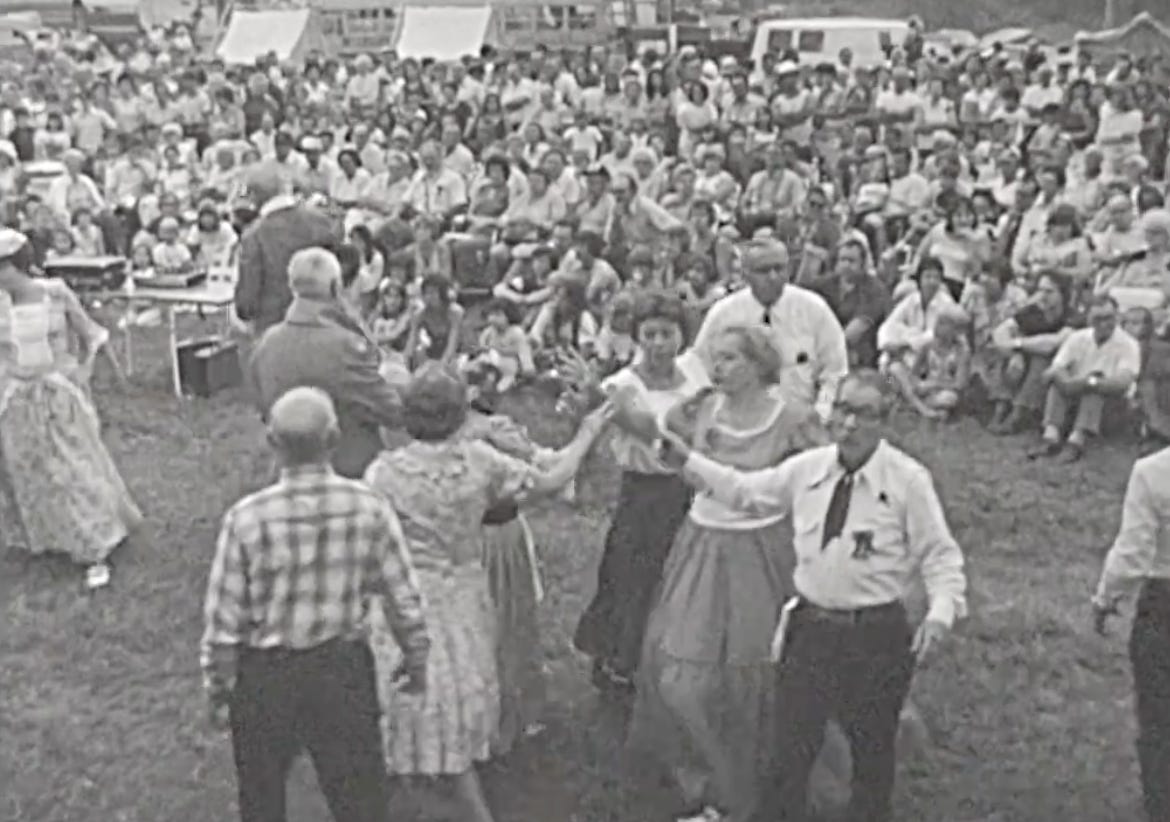
This was not a parade. This was a visit. The wagon train stayed overnight, camped in fairgrounds and local parks, and the townspeople came to them. Spectators watched the ritual of unhitching, watering, feeding, and grooming the horses. Kids got to touch the wagons. Families shared meals with the wagoneers around campfires. It was part county fair, part living history exhibit, part something that doesn’t really have a name anymore.
And then there were the scrolls.
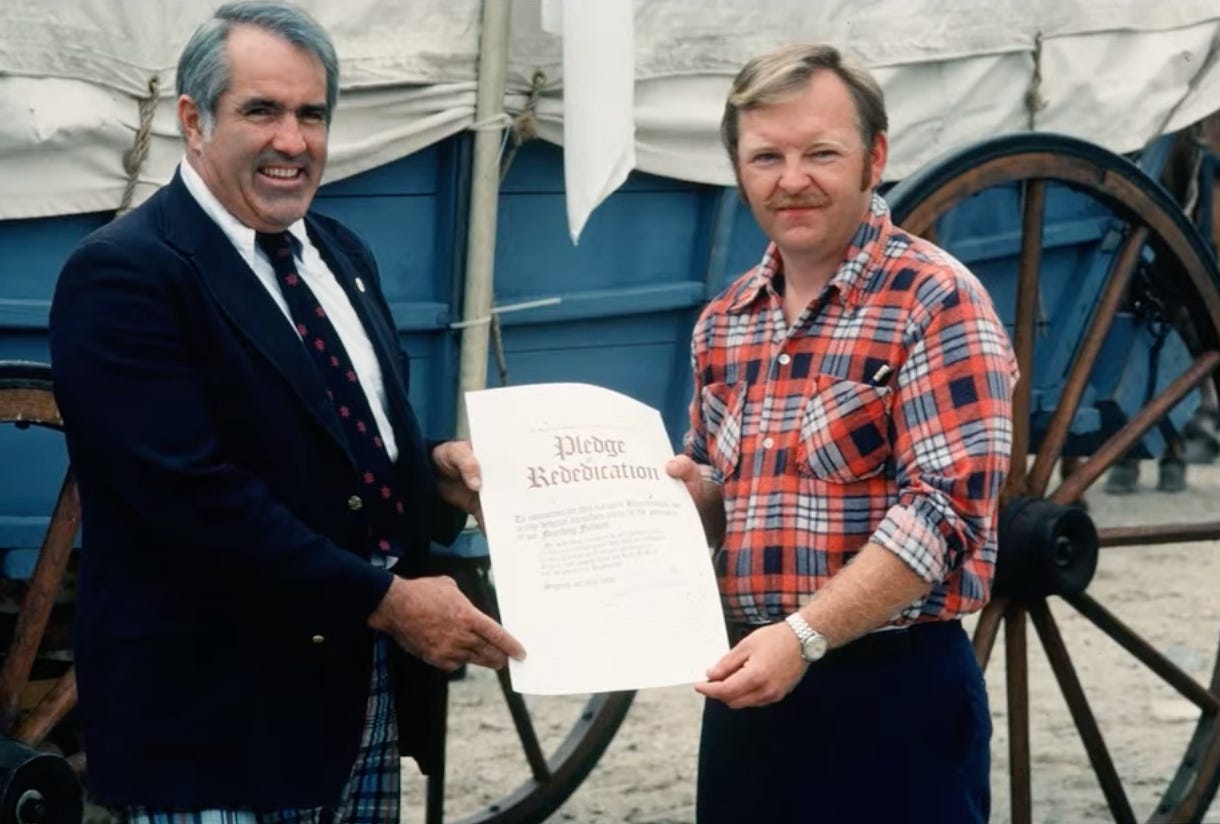
At every encampment, a small stage appeared — maybe 10 by 12 feet, draped in stars and stripes. Behind a table sat a woman in a colonial dress. On the table were the Rededication Scrolls. Each scroll had spaces for 24 signatures. You sat in a chair, picked up a pen, and signed your name beneath a pledge reaffirming your belief in the principles of the Declaration of Independence. One boy in Wisconsin used a fountain pen and India ink because his mother said it would be more authentic.
Pony Express riders on horseback fanned out from the main train, galloping into surrounding towns that weren’t on the wagon route. They picked up signed scrolls from Bicentennial communities and delivered them back to the state wagons. In Kansas, saddle club members relayed scrolls from town to town in a chain — one group riding from the county line, handing off to the next group at a crossroads, who handed off to the next at the edge of town. The scrolls piled up inside the wagons like cargo.
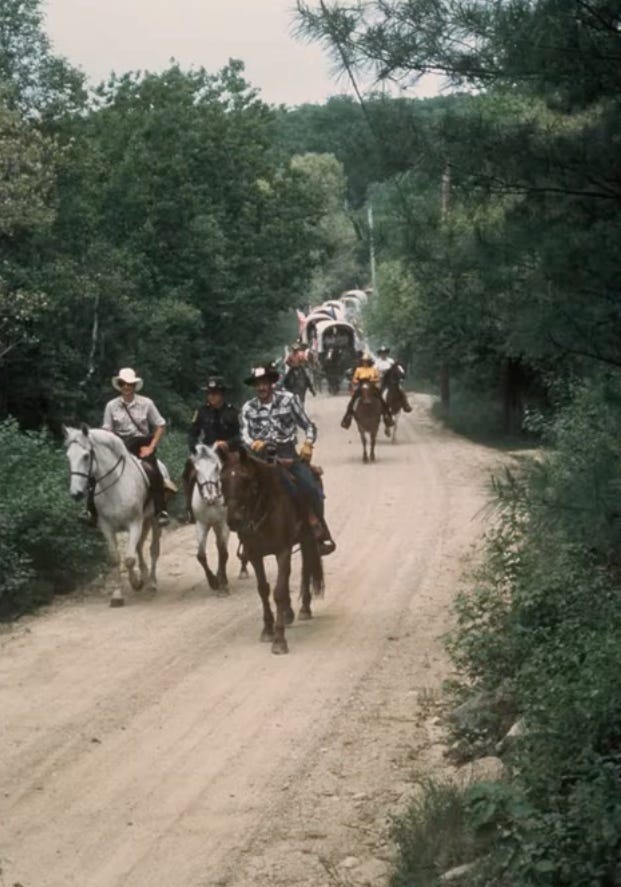
Some people joined for a day. Some joined for a week. A few quit their jobs, pulled their kids from school, and rode the whole way. Marilyn “Micki” Robison of Naches, Washington, served as National Trails Coordinator, crisscrossing the country to keep all seven trains on schedule. She hired and fired staff, solved problems, and rode alongside whenever she could. By the end, she was the only person who had seen every train.
People brought their own wagons. The program had provided official Conestoga replicas for each state, but the rules said anyone with a wagon and horses could ride along. The group swelled from a couple hundred participants to over a thousand. By the time the trains converged on Pennsylvania, 300 wagons and nearly 5,000 people on horseback were heading for Valley Forge.
Somewhere along the way, the pilgrimage stopped being a government program and became something else. It became the trip. It became the story these people would tell for the rest of their lives. One participant’s daughter later described the July 4th arrival as bittersweet — because when it was over, the people she’d spent months with on the road were going home. It was all over. Like the little bit of sadness people feel on New Year’s Eve. You look forward to something for so long and then — that’s it.
But first they had to get to Valley Forge. And that’s next.
This is Part 2 of a three-part series on the Bicentennial Wagon Train Pilgrimage. Part 3, arriving the last Sunday in June, covers the arrival at Valley Forge, the morning President Ford flew in by helicopter, and the 22 million signatures that vanished.
If you rode with the wagon train — or watched it come through your town — the Bicentennial Wagon Train Pilgrimage to Pennsylvania 1976 Facebook group is collecting memories, photos, journals, and audio recordings from participants. They’ve been at it for years. Go say hello!
Did You Know?
The Penn State wagon train show had a 30th anniversary reunion in 2006. Original cast members returned to Penn State to rehearse and perform the show again, then took it on the road to Fort Roberdeau, a Revolutionary War-era fort near Altoona. At sunset, the field looked like Valley Forge.
The wagons traveled by river, too. On sections where the trail crossed major waterways, the wagons were loaded onto barges and floated — down the Missouri, Mississippi, and Ohio rivers. In Wheeling, West Virginia, a barge carrying the wagon train docked overnight at the wharf. The local paper covered it like a UFO sighting.
Bill Howard, who led the Western States’ segment into Valley Forge, was one of only a few Americans certified to handle a six-horse Conestoga team. His own team of dappled gray Percheron draft horses pulled a Conestoga that had been displayed around the tri-state area before the pilgrimage began.
Corporate sponsors included Gulf Oil, Holiday Inns, and the Aero-Mayflower Transit Company. The official wagons were crafted in Arkansas. Insurance and small salaries of $100/month for wagonmasters were part of the budget. But most participants were volunteers who paid their own way.
Your Turn
If the wagon train came through your town, what do you remember? The horses? The show? The scroll table? Did your school band play? Did you sign a scroll? Did someone in your family ride along for a day or a week?
Drop your memory in the comments below.
In 27 days, America turns 250. Fifty years ago this summer, people quit their jobs to ride in covered wagons across the country for a birthday party. What would it take to make you do something like that today?
—Denyse
Bicentennial Memory Project
YouTube video library of the Bicentennial Wagon Train: