Your Bicentennial Memories Are Here: Somebody Approved a Wagon Train
In 1975, an ad agency in Philadelphia convinced the federal government to send covered wagons across America. The memos are unbelievable.

In a archival box at the Gerald R. Ford Presidential Library, there is a memo from 1975 about horse feed logistics across state lines.
It is typed on official White House stationery. It is addressed to a senior advisor to the President of the United States. And it is dead serious about the question of whether Conestoga wagon wheels need roller bearings for modern highways. This is how the Bicentennial Wagon Train Pilgrimage to Pennsylvania got approved. With memos.
Before we go any further — if you’re enjoying these Sunday letters, subscribe so you never miss one. They’re free, and they land in your inbox every week through July 2026.
Here is what actually happened.
In the early 1970s, the Bicentennial Commission of Pennsylvania had a problem. The nation’s 200th birthday was coming. Every state wanted a piece of the celebration. But Pennsylvania — home of Independence Hall, the Liberty Bell, and Valley Forge — felt a particular ownership of July 4, 1776. They needed something big. Something no other state could copy.
Someone in a conference room in Philadelphia said the words “wagon train.”
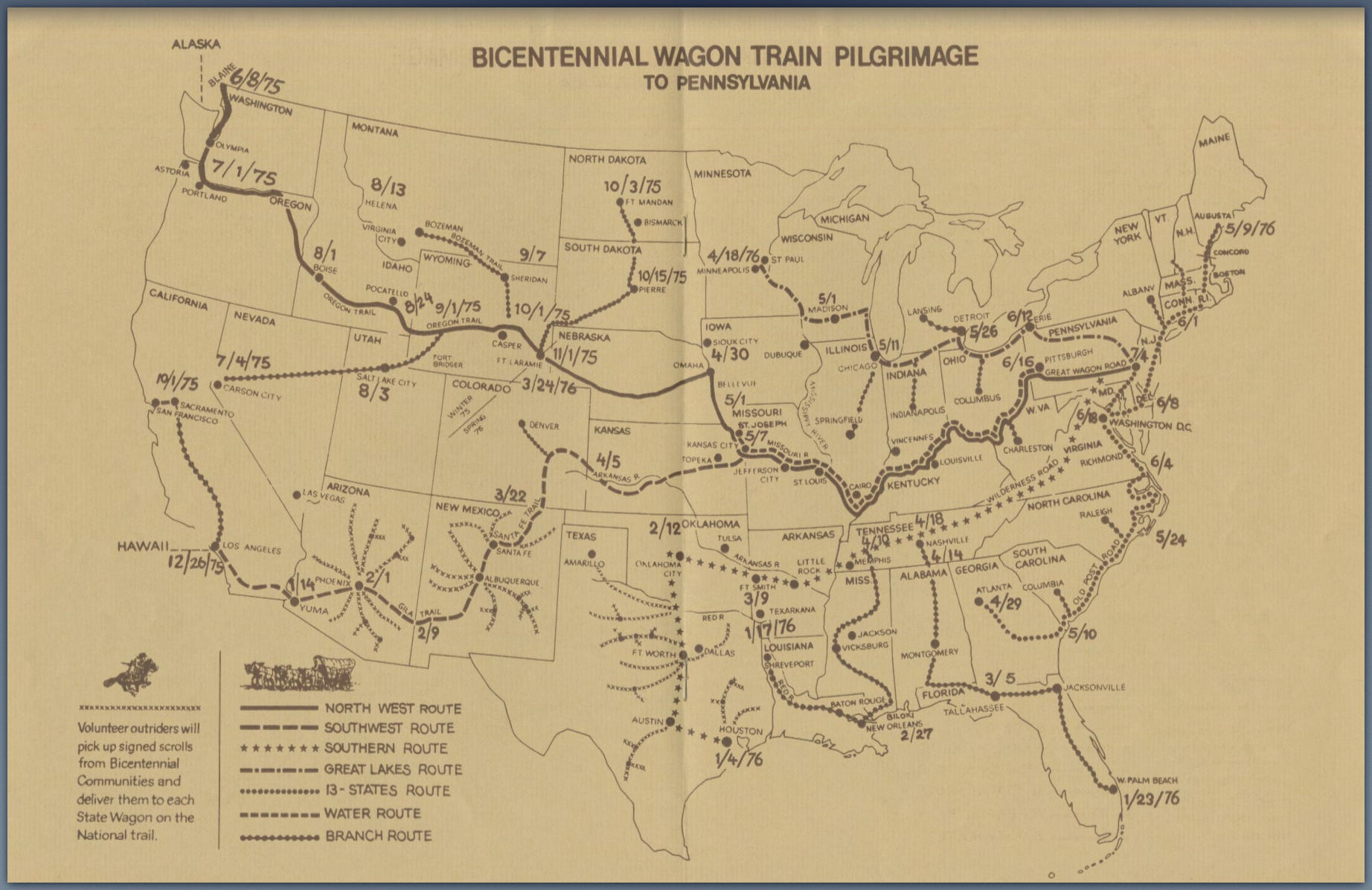
The pitch was simple and completely insane. Build authentic replicas of Conestoga wagons and Prairie Schooners — one for every state in the union. Hitch them to teams of draft horses. Send them west to east across the entire country, reversing the path of westward expansion. Have them follow the actual historic trails — the Oregon Trail, the Santa Fe Trail, the Mormon Trail, the Natchez Trace. Collect signatures from Americans along the way on “Rededication Scrolls” reaffirming their belief in the nation’s founding principles. And bring it all home to Valley Forge by July 4, 1976.
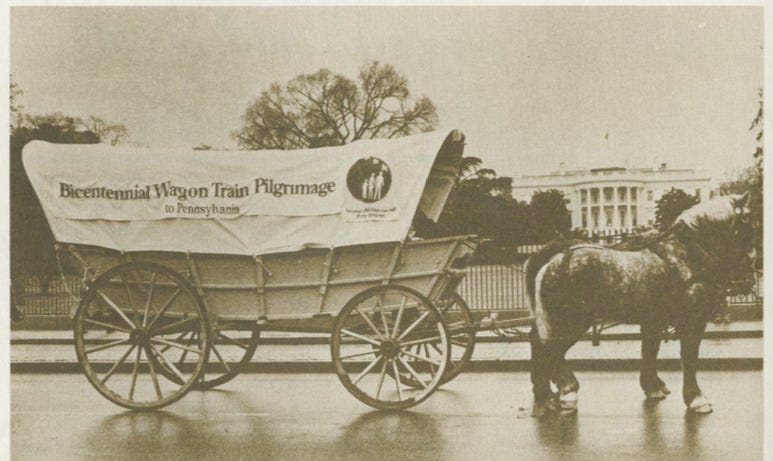
The whole thing would take over a year.
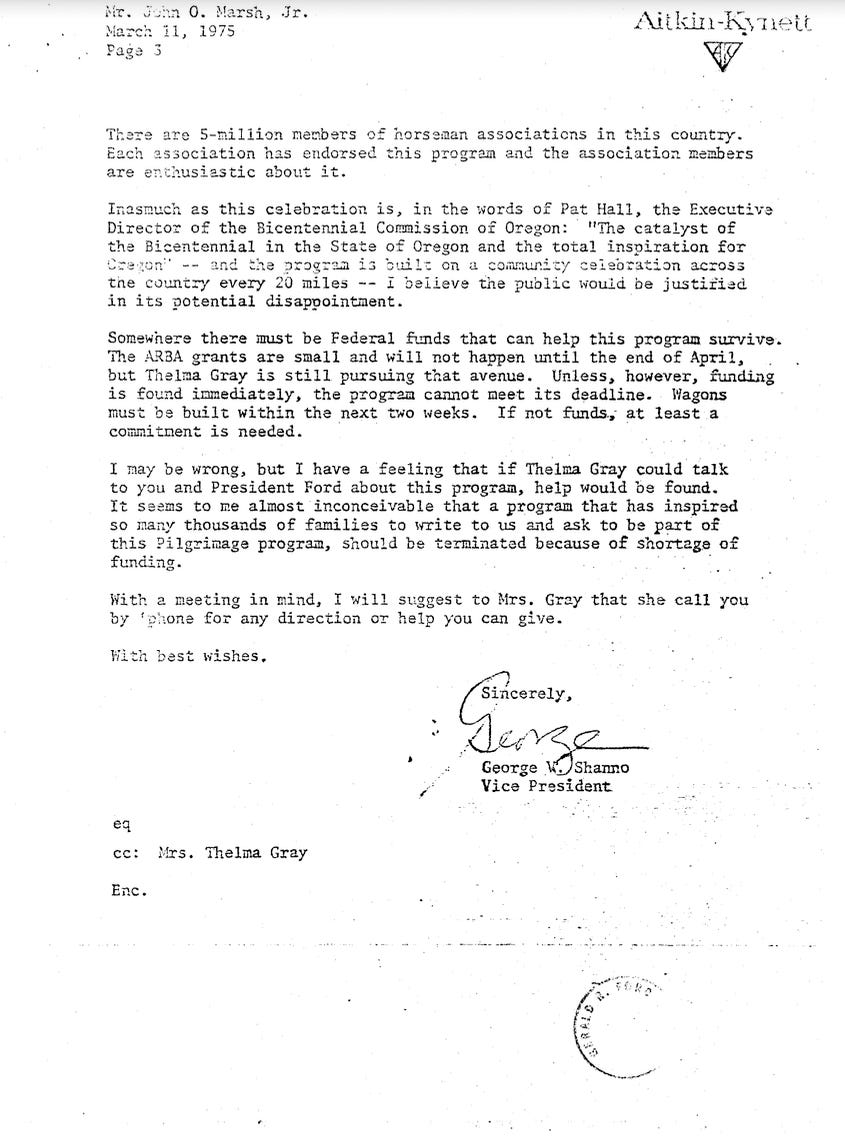
The ad agency managing the program, Aitkin-Kynett of Philadelphia, wrote to the White House in early 1975 with an urgent message. The economy was shaky. Major corporations were sitting on their wallets. The first wagons were scheduled to roll on June 8, 1975, and the funding wasn’t there.
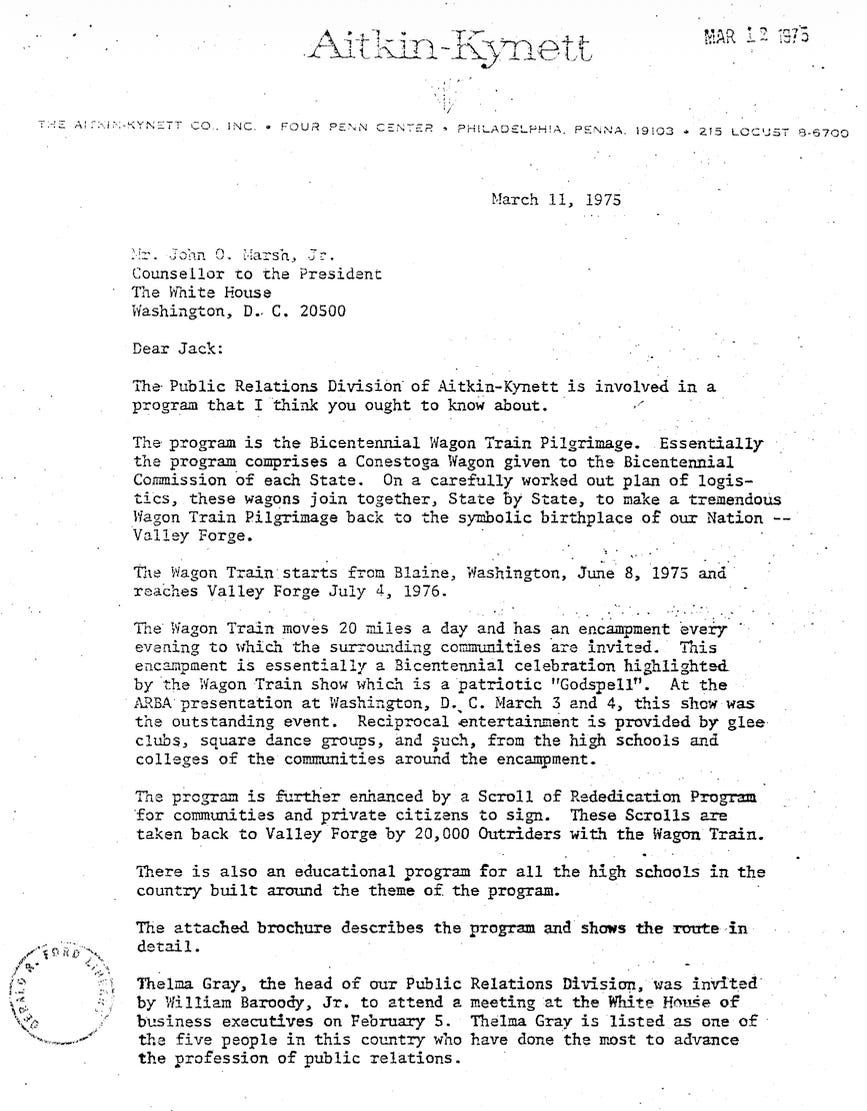
George Shannon, vice president of Aitkin-Kynett, put it plainly in a letter to John Marsh, Counselor to the President. The press had picked up the story because it was dramatic and romantic. Americans from coast to coast were writing in, desperate to participate. But the money hadn’t followed the excitement. Shannon warned that if the program collapsed, the public would blame the government, because people assumed something this big had to be a government program.
And then he wrote a line that belongs in a time capsule: “It is my personal belief that there will be a national hue and cry if this program is terminated.”
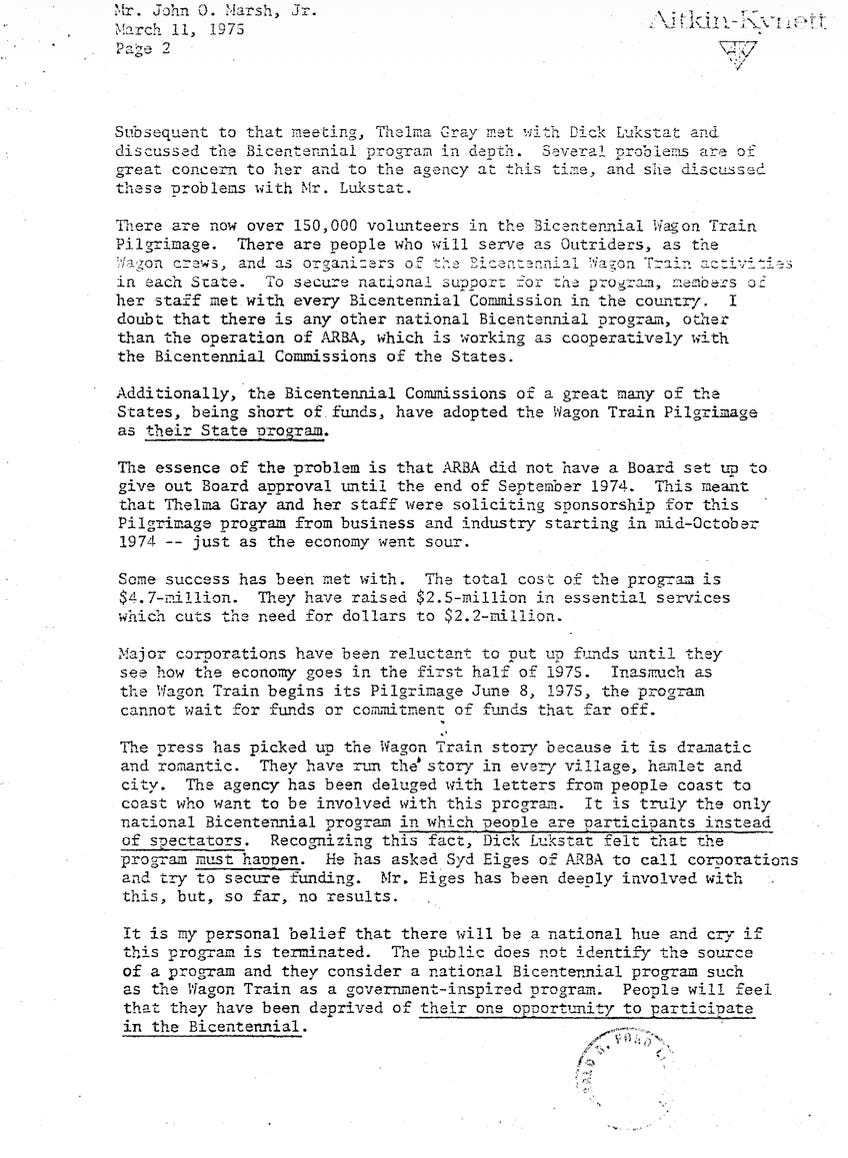
He was right. The program did not get terminated.
Five separate wagon train segments launched from different parts of the country. The Northwest route started at the Peace Arch in Blaine, Washington. Another began in California. A third wound up from the deep South. They followed seven different historic routes, rolling through towns and cities at about 20 miles a day — roughly the same pace as wagons 150 years earlier. The horses wore special borium shoes for traction on modern pavement. The wagons had roller bearings hidden in the wheels and hard rubber treads on the rims.
At every stop, the wagons put on a show. Penn State University’s Department of Theatre and Music had written a patriotic musical specifically for the pilgrimage. A press release from the period described the audience reaction as ranging “from cheers to tears and from bravos to hysteria.” Local glee clubs and square dance groups performed in return. School bands came out. Pony Express riders on horseback fanned out from the main train, picking up signed scrolls from surrounding towns and delivering them to the state wagons.
Then came the horses.
An Associated Press story out of San Diego reported that animals on a wagon trek were being mistreated. The story went national. Letters poured into the White House and the Pennsylvania Bicentennial Commission. Animal rights groups reprinted the story and circulated it widely.
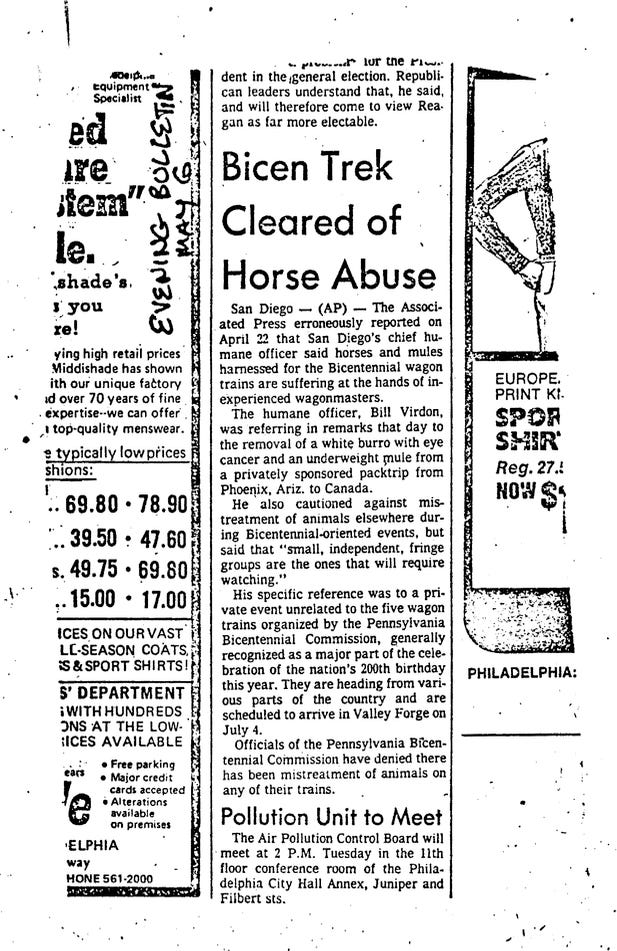
There was just one problem. The story was about two teenagers riding mules from San Diego to Canada. It had nothing to do with the official Bicentennial Wagon Train Pilgrimage. The AP had garbled it.
George Ebner, executive director of the Pennsylvania Bicentennial Commission, was not amused. He fired off a letter that is still in the Ford Library files. He noted that thousands of horses had been used, thousands of individuals had loaned or rented their livestock, and he had not received a single complaint of mistreatment. The commission brought in Dr. Thomas Dunkin, a veterinarian of 10 years, founder of the National Association of Equine Practitioners, and member of the USDA’s Advisory Board on Equine Policy. Dunkin examined the animals personally. His assessment: the horses were doing fine. And in fact, some of them were getting fat.
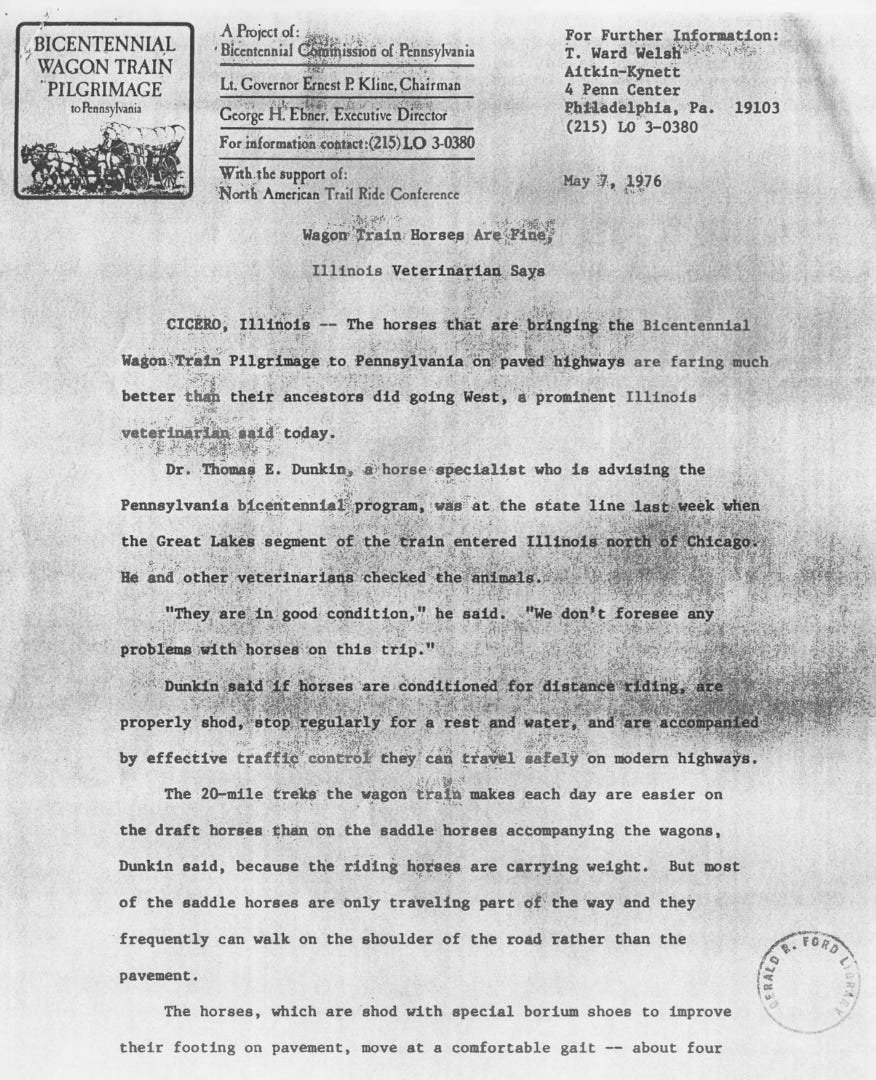
“We tend to forget these animals are created to pull and they love it,” Dunkin said.
The wagons kept rolling.
By the time the pilgrimage ended, 22 million Americans had signed Rededication Scrolls. That was roughly one in ten people in the country. Women in colonial dresses sat at little stages with stars and stripes, at tables with chairs, in towns from Oregon to Georgia, handing out scrolls for anyone to sign.
Where are those 22 million signatures today? Nobody knows for certain. The scrolls were supposed to be enshrined at Valley Forge. But over the decades, they seem to have disappeared. These stacks of paper that, laid flat, would stand as tall as a 20-story building. The last people who might have known where they went are gone.
The wagons arrived at Valley Forge on July 3, 1976. President Ford flew in by helicopter the next morning to greet the wagonmasters and accept the scrolls. We’ll get to that day. But not yet.
This is Part 1 of a three-part series on the Bicentennial Wagon Train Pilgrimage. Part 2 covers what the journey was actually like — the daily rhythm of life on the road, the towns that came out, and the show that traveled with the wagons. Part 3 arrives the last Sunday in June, the week of the Valley Forge anniversary itself.
Before we go — there is a Facebook group called Bicentennial Wagon Train Pilgrimage to Pennsylvania 1976 that has been collecting memories from actual participants for years. Photos, journals, audio cassette recordings from people who were on the train or watched it roll through their towns. If you have a connection to this story, go find them. It’s awesome what they have collected.
Did You Know?
The wagons traveled seven different historic routes — including the Oregon Trail, Santa Fe Trail, Mormon Trail, and the Great Wagon Road through the Appalachians — and made 249 official encampments over 15 months.
The entire program was managed by an ad agency. Aitkin-Kynett of Philadelphia, a full-service advertising firm, handled logistics, press releases, and crisis communications for a cross-country wagon train. Their letterhead is on the official horse care press releases.
President Ford’s July 4th schedule was extraordinary. He attended church at 7:30 AM, flew to Valley Forge to greet the wagons, helicoptered to Independence Hall in Philadelphia, then flew to New York Harbor to review Operation Sail and the Tall Ships — all before watching fireworks from the Truman Balcony that night.
Your Turn
Did the wagon train come through your town? Did your family go out to see it? Were you one of the 22 million who signed a Rededication Scroll? Tell us what you remember — the wagons, the horses, the show, the scroll table with the lady in the colonial dress.
Email your memory to bicentennialmemoryproject@gmail.com or drop it in the comments below.
In 48 days, America turns 250. In 1976, Americans across the country volunteered to lead covered wagons across the country to mark the moment. There’s people who still remember this. Talk to them and share the memories.
—Denyse
Bicentennial Memory Project
The Bicentennial Memory Project runs through July 2026. If you have a memory from 1976 — something you saw, something your family did, something you found in the attic — we want to hear it. Send your story to bicentennialmemoryproject@gmail.com.